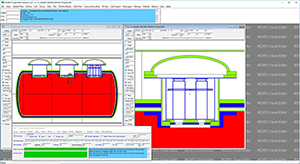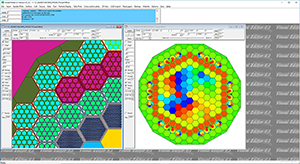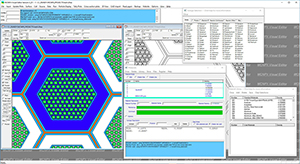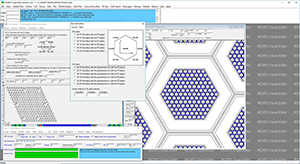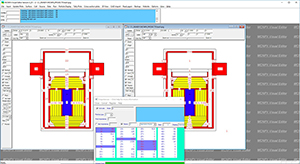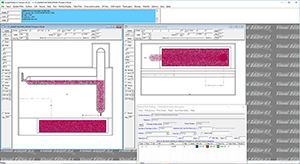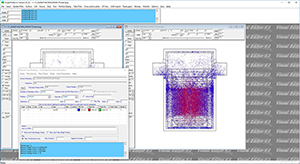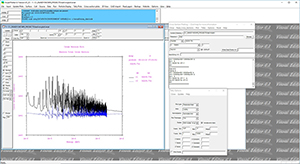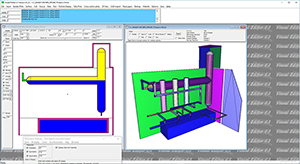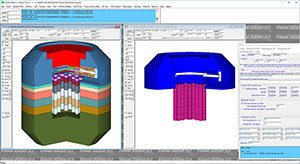
The current RSICC MCNP5(1.5)/MCNPX(2.6) release ONLY includes the MCNPX Visual Editor. The RSICC release does NOT include an MCNP Visual Editor or a Linux version of the Visual Editor.
The MCNPX Visual Editor shipped with the current RSICC release (MCNPX Version 2.60). A more recent beta version is available to students who attend any Visual Editor Consultants MCNP/MCNPX training class. A version that is more recent than the RSICC release is also available on the LANL MCNPX Beta Site however it is not as current as the beta used for the training classes.
See Videos of the MCNPX Visual Editor's capabilities. Click Here.
The Visual Editor was adapted to work with MCNPX through a grant from NASA. To download the report issued to NASA at the conclusion of the Phase 2 grant (issued November 2008. 7.5 Meg), Click Here.
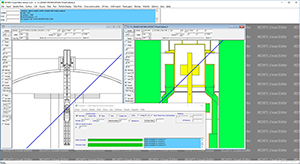
See the PowerPoint Presentation given at the 2008 Winter ANS Meeting in Reno. Click Here (File Size 5 Meg. .pdf format).
Surface Creation
For more detailed information on surfaces, Click Here
Sample Exercises: Creating the Simplest Surface, Using All the Surface Creation Tools
Cell Creation
For more detailed information on cells, Click Here.
Sample Exercises: A General Exercise Showing the Creation of an MCNPX Input File, Cell Sense Illustration
Displaying an MCNP Input File
For more detailed information on the Visual Editor's 2D display capabilities, Click Here.
Sample Exercises: A General Exercise Showing the Display of an Existing Input File.

Materials/Materials Library
For more detailed information on the use of Materials in the Visual Editor, Click Here.
Sample Exercises: Using the Material Library, Creating a Material

Lattice Creation
For more detailed information on the using the Visual Editor to Create Lattices, Click Here.
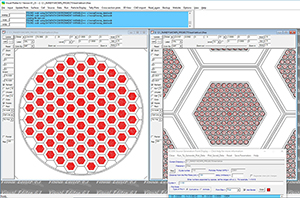
Sample Exercises: Creation of a 2D Rectangular Lattice, Creation of a 3D Rectangular Lattice, Modifying the Center of an Existing Rectangular Lattice, Creation of a 2D Hexagonal Lattice, Creation of a 3D Hexagonal Lattice, Modifying the Center of an Existing Hexagonal Lattice.

Setting Importances
For more detailed information on setting Importances, Click Here.
Sample Exercises: Importances
Source Points
For more detailed information on plotting Source Points, Click Here.
Sample Exercises: SDEF Source Plot, KCODE Source Plot
Collision Points/Particle Track Plotting
For more detailed information on plotting Collision Points, Click Here.
Sample Exercises: Particle Track Plotting
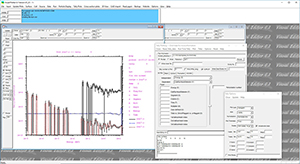
Cross Section Plotting
For more detailed information on cross section plots, Click Here.
Sample Exercises: Cross Section Plotting
3D Dynamic Plotting
For more detailed information on dynamically viewing a geometry in 3D, Click Here.
Sample Exercises: 3D Dynamic Plotting, 3D Dynamic Plotting with an Incomplete Input file
KCODE Source Generation
For more detailed information on KCODE Source Generation, Click Here.
Sample Exercises: KCODE Source Plot
3D Plots
For more detailed information on 3D Ray Traced Images, Click Here.
This image is the Zubal Head included with the medical physics input files in the MCNPX distribution.
Sample Exercises: 3D Ray Traced Plot, 3D Ray Traced Plotting - Detailed Discussion on Setting Viewpoints, 3D Ray Traced Plot with Cut-Away View - Part 1 - Create the Cookie Cutter Cell, 3D Ray Traced Plot with Cut-Away View - Part 2 - Display
3D Radiographic Plots
For more detailed information on 3D Radiographic Images, Click Here.
Sample Exercises: 3D Radiographic Plot,

Tally Plotting
For more detailed information on Tally Plotting, Click Here.
Sample Exercises: Tally Plotting,
Run MCNPX
For more detailed information on running MCNPX from inside the Visual Editor, Click Here.
CAD Import
For more detailed information on the CAD Import feature, Click Here.
Sample Exercises: 3D CAD Import of a Cube, 3D CAD Import of a More Complex File
Surface Wizard
For more detailed information on Surface Wizard Click Here.
Copying Plots to the clipboard
For more detailed information on copying plots to the clipboard, Click Here.
Do Not Modify Input Option
Another user concern is the Visual Editor modifies the input file, changing the format and order of the data within the input file. A new file->open option has been added to the Visual Editor to allow the user to open an input file without modification by the Visual Editor. In this mode, no changes are made to the input file and the un-modified input file can be viewed in the input window. However, because the Fortran to Visual Editor interface has been bypassed, none of the creation capabilities will be available in this mode. Display capabilities such as particle tracks, 3D ray-traced images, tally plots and cross section plots can still be generated.
This mode can be used by users who only want to generate display data and are not creating or modifying the input file.