3D Plotting

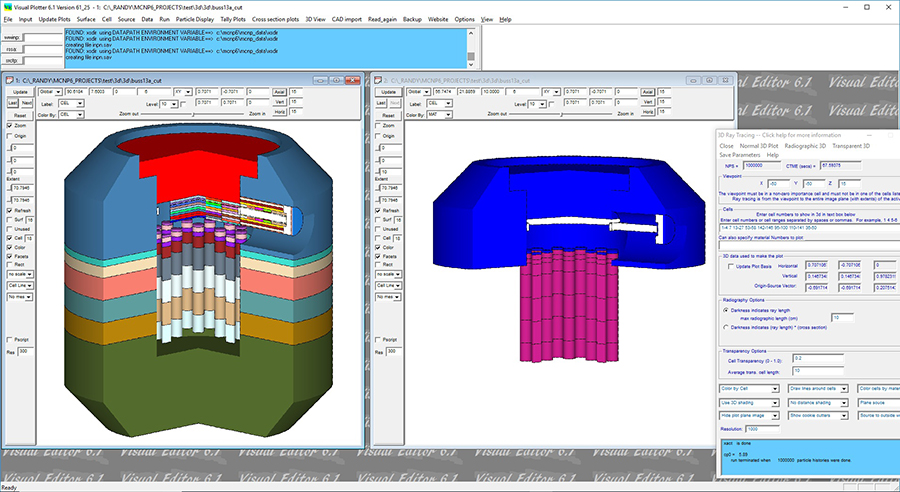
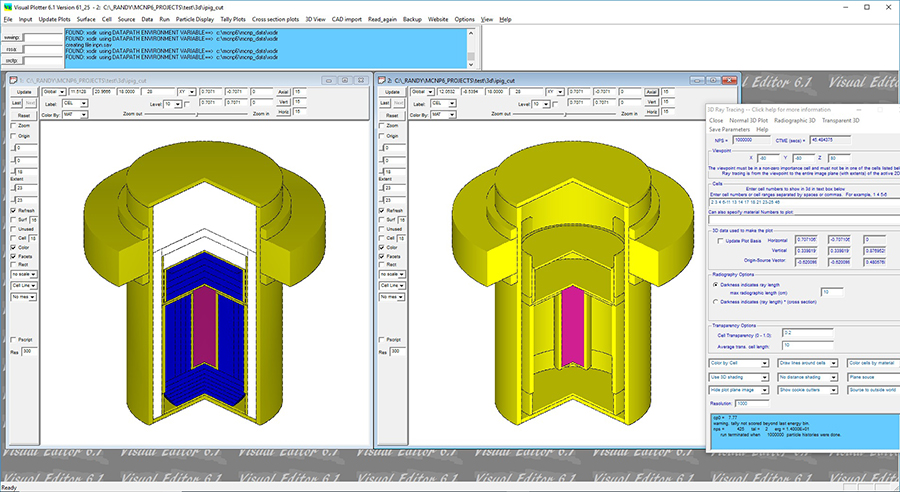
This is a 3D view of a cask with a section cut out. The plot was generated by reading in the cask input file and then adding a cookie cutter cell. This cookie cutter cell is used to cut away a region of the geometry, in this case a quarter of the cask. Next a viewpoint is selected. This will be the location where the rays start from. The user must also select the cells to be displayed in 3D. Notice in this example a range is selected (1-49). If non-existant cells exist in this range, a warning message will be printed and the cell will be ignored. The outside world can not be included in this range since the 3D plot is generated by running rays from the viewpoint to the outside world or the first specified cell.
Additional 3D Ray Trace Images are shown below:
Below is a buss cask.

Below is a human brain.

“3D model of the Zubal head included in the medical physics input files provide with the MCNP distribution.”
Below is a more complete reference from the input file:
Modified Zubal Head Phantom
Modified Zubal Phantom Input Deck by Jeff Evans. Revisions by Chenguan Li.
Department of Mechanical Engineering, The Ohio State University, Columbus 43210, USA.
Based on the Zubal Phantom. ref -
I. G. Zubal, C. R. Harrell, E. O. Smith, and A. L. Smith,
"Two dedicated software, voxel-based, anthropomorphic (torso and head) phantoms,"
in Proceedings of the International Workshop, National Radiological Protection Board,
Chilton, UK, on 6 and 7 July 1995, edited by P. J. Dimbylow (NRPB, Chilton, 1996), pp. 105–111.
This geometric model has been used in: J.F. Evans, T. E. Blue, N. Gupta,
"Absorbed dose estimates to structures of the brain and head using a high-resolution
voxel-based head phantom." Med Phys. 2001 May;28(5):780-6.